Dirt Rich: How the Rise of Carbon Farming Is Putting Money in Farmers' Pockets — and Carbon Back in the Ground
For most of American agricultural history, soil has been treated as a medium — something to hold crops in place while fertilizers and pesticides did the heavy lifting. Generations of tillage, monoculture, and chemical dependency have stripped vast stretches of American farmland of their organic matter, leaving behind compacted, carbon-depleted earth that struggles to support healthy yields without ever-increasing chemical inputs.
Now, a convergence of climate urgency, corporate sustainability pledges, and ecological science is reframing that depleted soil not as a liability, but as an asset — one that farmers can actively rebuild and, increasingly, sell.
Welcome to the soil carbon market.
What Carbon Farming Actually Means
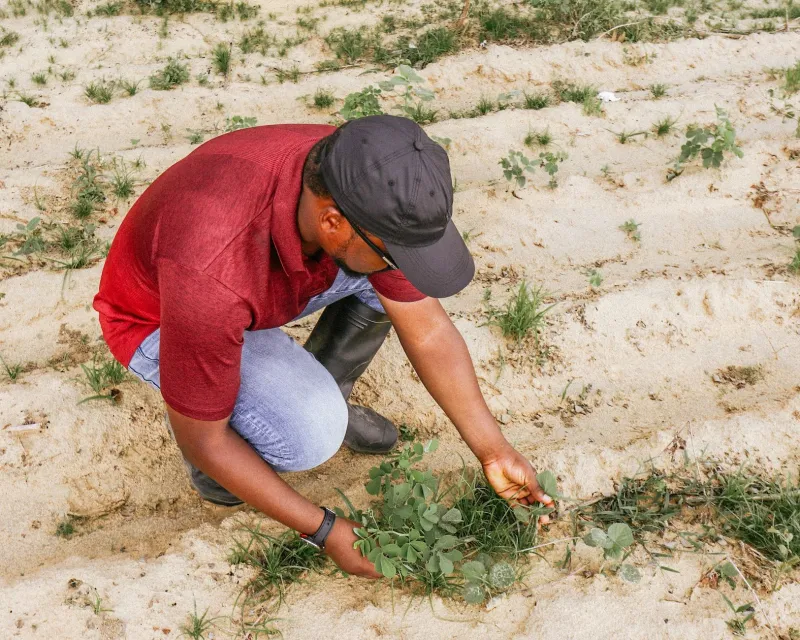
At its core, carbon farming refers to a suite of agricultural practices designed to draw carbon dioxide out of the atmosphere and lock it into the soil as organic matter. Regenerative techniques such as cover cropping, reduced tillage, compost application, and rotational grazing all contribute to this process by feeding the microbial ecosystems that convert plant material into stable soil carbon compounds.
Healthy soil isn't just an environmental abstraction. Farms with higher organic matter content retain water more effectively, require fewer synthetic inputs, and tend to produce more resilient yields over time. The climate benefit, however, is what has attracted an entirely new class of investor to American agriculture.
When soil carbon levels increase, carbon that would otherwise remain in the atmosphere — contributing to warming — is instead sequestered belowground. Scientists estimate that global agricultural soils have lost between 50 and 70 percent of their original carbon stock since the dawn of industrial farming. Restoring even a fraction of that capacity could represent a meaningful contribution to national and global emissions reduction goals.
The Market Takes Shape
Over the past five years, a wave of companies has moved to monetize this potential. Firms such as Indigo Ag, Nori, Soil Carbon Initiative, and TerVia have built platforms that connect farmers willing to adopt regenerative practices with corporations eager to purchase carbon offsets as part of their sustainability commitments.
The mechanics vary by program, but the basic structure is consistent: a farmer enrolls, agrees to implement specific practices, and allows the company to measure changes in soil carbon over time — typically through a combination of soil sampling and modeling software. When sequestration is verified, the farmer receives credits that are sold on voluntary carbon markets, often to Fortune 500 companies looking to offset their Scope 1 or Scope 2 emissions.
Payouts have ranged from roughly $15 to $50 per metric ton of carbon dioxide equivalent, depending on the program and market conditions. For a mid-sized row crop operation in the Midwest, that can translate to meaningful supplemental income — sometimes thousands of dollars annually — without requiring a complete overhaul of the farming operation.
For farmers already squeezed by thin margins and volatile commodity prices, the appeal is considerable.
The Science Beneath the Surface
The ecological rationale for soil carbon sequestration is well-established. What remains contested is the precision with which it can be measured, verified, and attributed to specific land management decisions.
Soil carbon is notoriously variable. Levels can fluctuate significantly across a single field, making it difficult to establish reliable baselines and detect incremental changes with statistical confidence. Sampling methods differ between programs, and many platforms rely heavily on predictive modeling rather than direct measurement — introducing uncertainty that critics argue is systematically underacknowledged.
Permanence is another challenge. Unlike carbon stored in geological formations, soil carbon can be released relatively quickly if land management practices change, if drought stress disrupts microbial activity, or if a farm is sold and the new owner returns to conventional tillage. Most crediting programs include provisions requiring farmers to maintain practices for a defined period, but enforcement across millions of acres of private land remains logistically complex.
The Intergovernmental Panel on Climate Change has acknowledged soil carbon sequestration as a legitimate mitigation pathway, while simultaneously cautioning that its potential has sometimes been overstated in policy discussions. Independent researchers have echoed that concern, noting that the gap between theoretical sequestration potential and what can be reliably credited under rigorous verification standards is substantial.
Greenwashing Concerns and the Integrity Question
The voluntary carbon market — of which soil carbon is a growing segment — has faced mounting scrutiny in recent years. Investigative reporting and academic analyses have documented cases in which credits were issued for forests that were never actually threatened, or for emissions reductions that would have occurred regardless of the program's existence.
Soil carbon programs have not been immune to criticism. A 2023 analysis published in Nature Climate Change found that several prominent agricultural carbon programs had issued credits based on modeled sequestration estimates that diverged significantly from measured outcomes. The study raised questions about whether corporate buyers were receiving genuine climate value or purchasing a form of environmental reassurance that the atmosphere would not recognize.
For the farmers participating in good faith and genuinely improving their soil health, the integrity debate can feel abstract. Many report tangible benefits — reduced input costs, improved water retention, better long-term productivity — that exist independently of whether a carbon credit ever changes hands. The regenerative practices themselves, they argue, are worth adopting on agronomic grounds alone.
But for the market to function as a climate tool rather than a public relations instrument, the accounting has to be honest. That means investing in better measurement technology, standardizing verification protocols across platforms, and building in conservative crediting buffers that account for the genuine uncertainty involved.
Federal Interest and the Road Ahead
The U.S. Department of Agriculture has taken increasing interest in this space, directing funding through the Inflation Reduction Act toward conservation programs that incentivize regenerative practices. The agency has also supported efforts to develop more standardized soil carbon measurement methodologies, recognizing that federal credibility will be essential if agricultural carbon markets are to scale responsibly.
Some advocates are pushing for a more direct public role — arguing that government-backed programs with transparent verification standards would be more effective than the current patchwork of private platforms operating under inconsistent rules. Others maintain that market competition will drive innovation in measurement and verification, ultimately producing more accurate and cost-effective solutions than a centralized regulatory approach.
What is not in dispute is the underlying need. American farmland covers roughly 900 million acres. Even modest improvements in average soil carbon content across that landscape would represent a significant contribution to the nation's climate commitments — and a meaningful improvement in the long-term health and productivity of the agricultural systems that feed the country.
The soil has been drawing down carbon for as long as plants have existed. The question now is whether the humans who manage it can do so deliberately, verifiably, and at a scale the climate actually requires. The market is betting they can. The science is still working out the terms.