Cultivating the Deep: How Kelp Farming Is Emerging as America's Most Promising Climate Crop
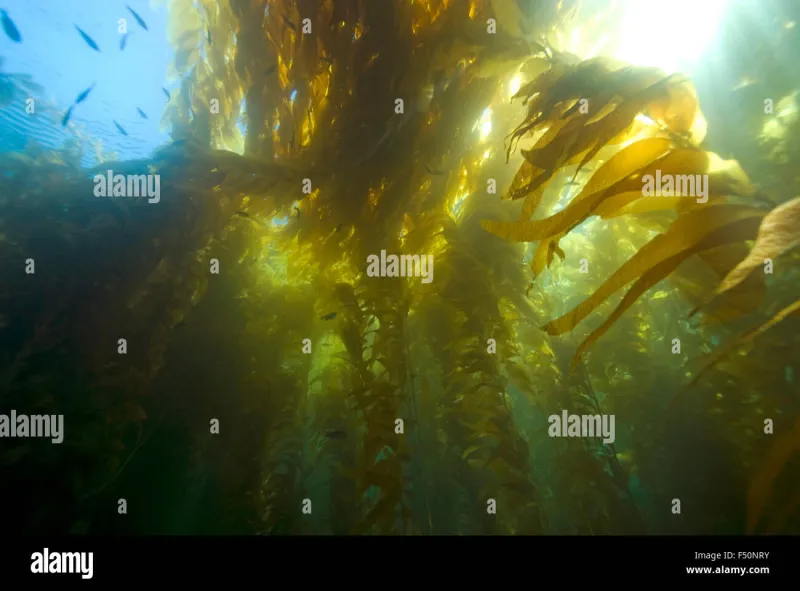
Photo: kelp seaweed farm ocean underwater California coast, via c8.alamy.com
Three miles off the coast of Santa Barbara, California, a grid of submerged ropes stretches across nearly two acres of Pacific Ocean. Attached to those ropes, in dense, undulating curtains, is giant kelp — Macrocystis pyrifera — growing at rates that can exceed a foot per day under optimal conditions. The farm belongs to a startup called Cascadia Seaweed's US partner operation, and its founders will tell you, with equal measures of scientific precision and evangelical conviction, that what they are growing may be one of the most consequential crops in the country.
The claim is not as extravagant as it sounds. Macroalgae — the broad category that includes kelp, dulse, and dozens of other seaweed species — photosynthesize at extraordinary rates, requiring no freshwater, no fertilizer, and no arable land. They absorb carbon dioxide and excess nutrients from the surrounding water as they grow. They can be harvested as food, processed into animal feed supplements that dramatically reduce methane emissions from cattle, refined into bioplastics, or sunk to the deep ocean floor as a form of long-duration carbon sequestration. The list of potential applications is long enough to seem implausible — yet the science underlying each of them is increasingly robust.
The Carbon Calculus
Seaweed's carbon sequestration potential has attracted particular attention from climate researchers. A landmark 2022 study in the journal Nature Climate Change estimated that, at theoretical maximum deployment, global macroalgae cultivation could sequester up to 1.5 billion metric tons of carbon dioxide annually — roughly equivalent to the annual emissions of the entire global aviation industry. Even at a fraction of that scale, the numbers are meaningful.
The sequestration mechanism is more complex than simple photosynthesis. When kelp grows, it absorbs dissolved CO₂ from seawater, which in turn draws down atmospheric CO₂ through the ocean's natural gas exchange processes. When harvested kelp is processed into durable products — bioplastics, construction materials, or long-lived soil amendments — that carbon remains locked away. When unharvested fronds detach and sink into deep water, a portion of the carbon they contain is sequestered on timescales of centuries.
The Woods Hole Oceanographic Institution and NOAA are currently co-running a multi-year study off the coast of Massachusetts to quantify sequestration rates under real-world farming conditions — data that will be essential for eventually certifying kelp farming as a credible carbon offset methodology. Voluntary carbon markets are watching closely; several major offset registries have indicated they are developing kelp-specific protocols.
Disrupting the Feed Lot
Perhaps the most immediately scalable application of seaweed cultivation lies not in carbon markets but in livestock agriculture. A red algae species called Asparagopsis taxiformis has been demonstrated, in peer-reviewed trials, to reduce methane emissions from cattle by 50 to 80 percent when incorporated into feed at concentrations as low as 0.2 percent of dry matter intake. Given that enteric fermentation — the digestive process by which ruminants produce methane — accounts for approximately 14.5 percent of global greenhouse gas emissions, the implications are staggering.
A California-based company, Volta Ocean, is already producing Asparagopsis at commercial scale and has supply agreements with beef and dairy producers across the western United States. The regulatory pathway for feed additives is well established, and the USDA's Agricultural Research Service has incorporated seaweed feed research into its climate-smart agriculture initiative. Several major US beef processors have quietly begun exploratory sourcing conversations.
The economics of feed-grade seaweed are currently constrained by production costs, but industry analysts project that at volumes of 10,000 metric tons annually — achievable within this decade under current growth trajectories — prices will fall to levels competitive with conventional feed supplements. At that point, the incentive for large-scale livestock operators to adopt the technology becomes primarily financial rather than environmental.
The Food on Your Plate
Beyond industrial applications, edible seaweed is staging a quiet entrance into mainstream American food culture. US per-capita seaweed consumption remains a fraction of what it is in Japan, South Korea, or coastal European nations, but the trend line is moving. Kelp noodles, dulse flakes, and dried wakame have migrated from specialty natural food stores to the shelves of Whole Foods, Trader Joe's, and, increasingly, conventional grocery chains.
New England has emerged as a particular hotbed of culinary seaweed entrepreneurship. Maine-based companies such as Atlantic Sea Farms have built vertically integrated operations that partner with lobster fishermen — whose traditional income is under pressure from warming Gulf of Maine waters — to cultivate sugar kelp on lines suspended beneath the surface. The kelp is harvested, processed, and sold as fresh, frozen, and dried product under retail and food service brands. Atlantic Sea Farms now works with more than 40 fishing families, representing a model of economic diversification for coastal communities facing climate-driven disruption to their traditional livelihoods.
Nutritionally, kelp and other edible seaweeds are extraordinarily dense: high in iodine, calcium, iron, and a suite of antioxidants, while delivering umami flavor profiles that food scientists describe as uniquely satisfying. For a country grappling with the environmental costs of protein-intensive diets, seaweed offers a food source that produces no methane, requires no land clearing, and actively benefits the marine ecosystems in which it grows.
Scaling the Challenges
The path to commercial-scale US seaweed farming is not without genuine obstacles. Permitting ocean aquaculture operations in federal waters involves a labyrinthine process spanning NOAA, the Army Corps of Engineers, state coastal management agencies, and, in some cases, the Coast Guard. Reform advocates have been pushing for a streamlined federal permitting framework for years; the Biden administration made incremental progress, and the issue retains bipartisan appeal given its potential to support coastal fishing communities.
Ecological concerns warrant serious attention as well. Large-scale monoculture seaweed farming, if poorly sited or managed, can alter local light penetration, affect native species composition, and introduce disease pressure. Researchers at the University of California Santa Barbara's Marine Science Institute are developing spatial planning tools to identify optimal farming zones that maximize productivity while minimizing ecological disruption. The goal, as lead researcher Dr. Carrie Harrington describes it, is "farming with the ecosystem rather than imposing upon it."
Water temperature and chemistry present additional variables. Warming ocean conditions have already stressed wild kelp forests along the California coast, and farm operators must increasingly account for climate variability in their site selection and species choices. Some operators are experimenting with heat-tolerant kelp strains developed through selective breeding — an approach that mirrors the climate adaptation strategies already common in terrestrial agriculture.
A Blue New Frontier
Federal investment is beginning to reflect the sector's potential. The Department of Energy's Advanced Research Projects Agency-Energy, known as ARPA-E, has committed $22 million to its Macroalgae Research Inspiring Novel Energy Resources program, funding projects ranging from offshore autonomous kelp cultivation platforms to novel biorefinery processes that extract multiple value streams from a single harvest. NOAA's Sea Grant program has similarly expanded its macroalgae research portfolio, with particular emphasis on supporting small-scale coastal farmers.
The convergence of climate urgency, coastal economic pressure, and advancing cultivation technology is creating conditions in which seaweed farming could scale from a promising experiment to a genuine industry within the decade. The crop requires no irrigation in a water-stressed nation, produces no agricultural runoff in an era of nitrogen-saturated watersheds, and grows in an environment — the ocean — that covers 71 percent of the planet's surface.
For the farmers tending those submerged rope lines off Santa Barbara, the future is already tangible, measured in the daily growth of fronds and the quiet expansion of something that looks, from the surface, like nothing at all.